
Two Very Different Commitments
Most homeowners shopping for a fire table with a natural stone surround start by browsing photos — and quickly realize the question isn’t just about looks. A fire table framed in stacked limestone or bluestone can anchor a patio in a way that feels architectural. But the moment you start pricing out that vision, a fork in the road appears: do you build it in, or do you buy a freestanding unit and let the stone work around it?
These are genuinely different decisions with different cost structures, different contractors, and different long-term implications. The gap between them is wider than most people expect.
A built-in fire table is set into a masonry structure — typically a custom-poured concrete base or a framed stone surround built by a mason. The fire table insert sits flush within the stonework, and the whole assembly is permanent. A freestanding fire table with a natural stone surface, by contrast, arrives as a complete unit: stone-finished tabletop, base, and burner assembly in one piece, ready to place on your patio without any construction.
Both configurations can use natural stone or stone-look materials. The difference lies in how that stone is applied, who installs it, and what happens if you change your mind in five years.
Installation Cost: The Number That Changes Everything
This is where the two paths diverge most sharply.
A freestanding fire table with a natural stone surface — like the Oriflamme line available at All Backyard Fun — typically runs between $2,100 and $3,500 for the unit itself, with no contractor required. Assembly is tool-free, and the stone-finished tabletop (fiberglass-reinforced quartz concrete in the case of the Oriflamme Savanna Stone or Glacier Stone models) is already built into the product. Total installed cost: the price of the table, plus a propane connection or an optional natural gas line if you want one.
A built-in fire table with a custom natural stone surround is a different financial conversation entirely. The masonry work alone — framing, footing, and stone installation — typically runs $4,000 to $15,000 depending on stone type and project scale. Natural stone materials cost $35 to $100+ per square foot for materials alone, and skilled masonry labor runs $50 to $100 per hour in most U.S. markets. Add a gas line run, permits (usually $150 to $500 for gas-connected permanent installations), and the fire table insert itself, and a built-in project with full natural stone work can land anywhere from $6,000 to $20,000 or more.
Outdoor installations also tend to cost more than comparable indoor work — site preparation, weatherproofing, and concrete footings all add to the total. If your patio isn’t already at grade or needs leveling, budget an extra $500 to $2,500 for that groundwork alone.
| Freestanding Fire Table | Built-In with Stone Surround | |
|---|---|---|
| Unit/Material Cost | $2,100–$3,500 | $4,000–$15,000+ |
| Installation Labor | Minimal / DIY | $2,000–$8,000+ |
| Permits | Usually none (propane) | $150–$500 (gas line) |
| Timeline | Same day | 1–3 weeks |
| Total Estimated Range | $2,100–$4,000 | $6,000–$20,000+ |
For buyers who want the look of natural stone without the construction cost, freestanding fire tables with stone-textured surfaces close a lot of that gap at a fraction of the price.
Flexibility vs. Permanence: What You’re Actually Trading
Built-in fire tables are permanent by design. Once the masonry is poured and the stone is set, the fire table is part of your patio. That’s a feature if you’re building a forever home and want an outdoor space that looks designed from the ground up. It’s a liability if your outdoor furniture layout evolves, you sell the house, or you simply want to rearrange things after a few seasons.
Freestanding units move. That sounds obvious, but it has real design implications. You can reposition a freestanding fire table to the center of a seating group, shift it to a covered area in shoulder seasons, or take it with you if you relocate. For renters, this is non-negotiable. For homeowners who haven’t fully committed to a patio layout, it’s a meaningful advantage.
There’s also a maintenance angle worth considering. Natural stone — whether in a built-in surround or as a surface finish on a freestanding table — needs periodic care. Outdoor stone surrounds typically need resealing every one to three years to protect against moisture and staining, with professional sealing running $200 to $500 per visit. A built-in structure also exposes more stone surface area to the elements, which means more maintenance surface overall.
Freestanding fire tables with stone-look surfaces tend to use engineered composites (like fiberglass-reinforced quartz concrete) that are specifically designed for outdoor exposure. These materials are weather-resistant by formulation, not by after-market treatment — a practical advantage in climates with hard freeze-thaw cycles or high humidity.
But permanence has its own upside: a well-built stone surround adds perceived value to a property in a way that a freestanding table generally doesn’t. Real estate professionals consistently note that permanent outdoor living features — fire features, outdoor kitchens, stone patios — register as upgrades during home appraisals in a way that furniture-category items do not.
Design Impact: Which Actually Looks Better?
Honest answer: it depends on the context, and “better” is doing a lot of work in that sentence.
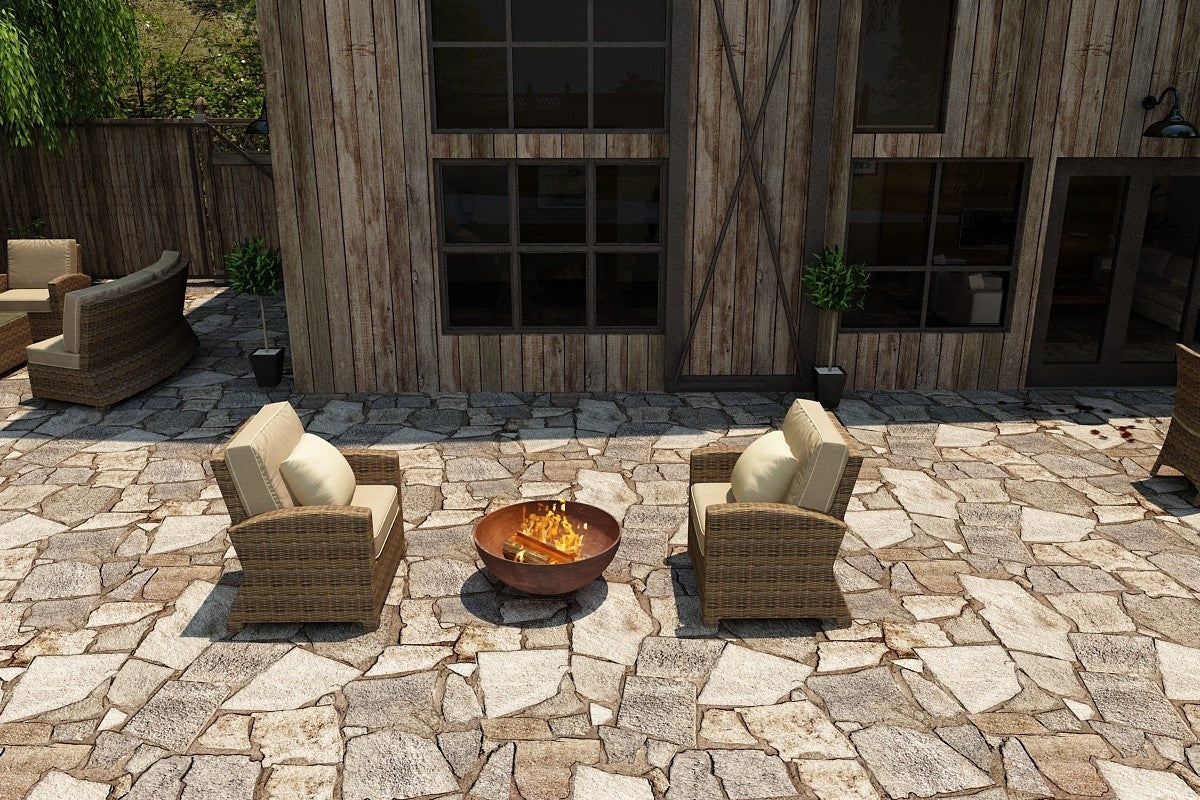
A built-in fire table with a full natural stone surround — think flagstone, limestone, or bluestone set in mortar around a recessed burner — creates a level of visual weight that a freestanding unit can’t match. The stone reads as architecture. It anchors the patio. When it’s done well, it looks like it was always there, not added later. For large patios with permanent seating walls, pergolas, or outdoor kitchens, the built-in approach tends to produce a more cohesive result.
Freestanding fire tables, though, have gotten considerably more sophisticated. The gap in perceived quality between a well-made stone-surface freestanding table and a modest built-in has narrowed. Hand-finished stone surfaces, stainless steel burners, and powder-coated bases now produce freestanding units that read as premium furniture — not as a compromise. The Oriflamme Glacier Stone and Savanna Stone fire tables, for example, use hand-troweled fiberglass-reinforced quartz concrete surfaces that have been refined over more than fifteen years of real-world use. At coffee table height (21¾"), they’re also sized to work within a seating group rather than sit apart from it — which shapes how a patio feels in use.
For smaller patios — say, a 12×16-foot space — a built-in structure can actually overwhelm the area. A freestanding table scales to the space in a way a masonry surround often can’t without careful planning.
So the design question isn’t really “which looks more impressive in a photo.” It’s whether your patio is designed around a permanent fire feature or whether the fire feature is designed to work within a flexible outdoor living setup.
Pros and Cons at a Glance
Built-In Fire Table with Natural Stone Surround
Pros:
- Architectural presence; looks designed into the space
- Potential to increase home appraisal value
- Fully custom — stone type, layout, and scale are your choice
- Can integrate seating walls, outdoor kitchen adjacency, and lighting
Cons:
- High upfront cost ($6,000–$20,000+ installed)
- Requires masonry contractor, permits, and a 1–3 week build timeline
- Permanent — repositioning or removing it is a demolition project
- More stone surface area to reseal and maintain over time
- Gas line connection typically required for permanent installation
Freestanding Fire Table with Natural Stone Surface
Pros:
- Lower total cost ($2,100–$4,000 in most cases)
- No contractor, no permits for propane configurations
- Portable — move it, rearrange it, take it with you
- Engineered stone surfaces designed specifically for outdoor exposure
- Available same-day or within standard shipping lead times
Cons:
- Less visual permanence than a masonry surround
- Propane tank management (refills, storage) vs. a dedicated gas line
- Doesn’t typically register as a structural upgrade for home value purposes
- Some configurations require freight delivery and curbside placement
Which One Should You Choose?
If you’re designing a large, permanent outdoor living space — full patio, seating walls, outdoor kitchen, the works — and you’re staying in the home long-term, a built-in fire table with a natural stone surround probably justifies the investment. The design cohesion and permanence are genuinely difficult to replicate with a freestanding unit, and the cost gets easier to absorb when it’s part of a larger project.
But if your patio is a mid-size residential space, if your layout isn’t fully locked in, or if you want fire table quality without a construction project, a premium freestanding fire table with a natural stone surface is probably the smarter move for 2026. The quality of engineered stone surfaces has reached a point where the visual trade-off is minimal, and the flexibility advantage is real.
For most homeowners, the freestanding path also means the fire table is ready to use this season — not after permits are pulled, a mason is scheduled, and mortar has cured.
All Backyard Fun carries a range of freestanding fire tables with natural stone surfaces, including multiple Oriflamme configurations in different sizes and finishes. If you’re still deciding between a built-in and freestanding setup, it’s worth comparing the total project cost of each against your actual patio dimensions and how you plan to use the space — the math tends to make the decision clearer than any design preference alone.