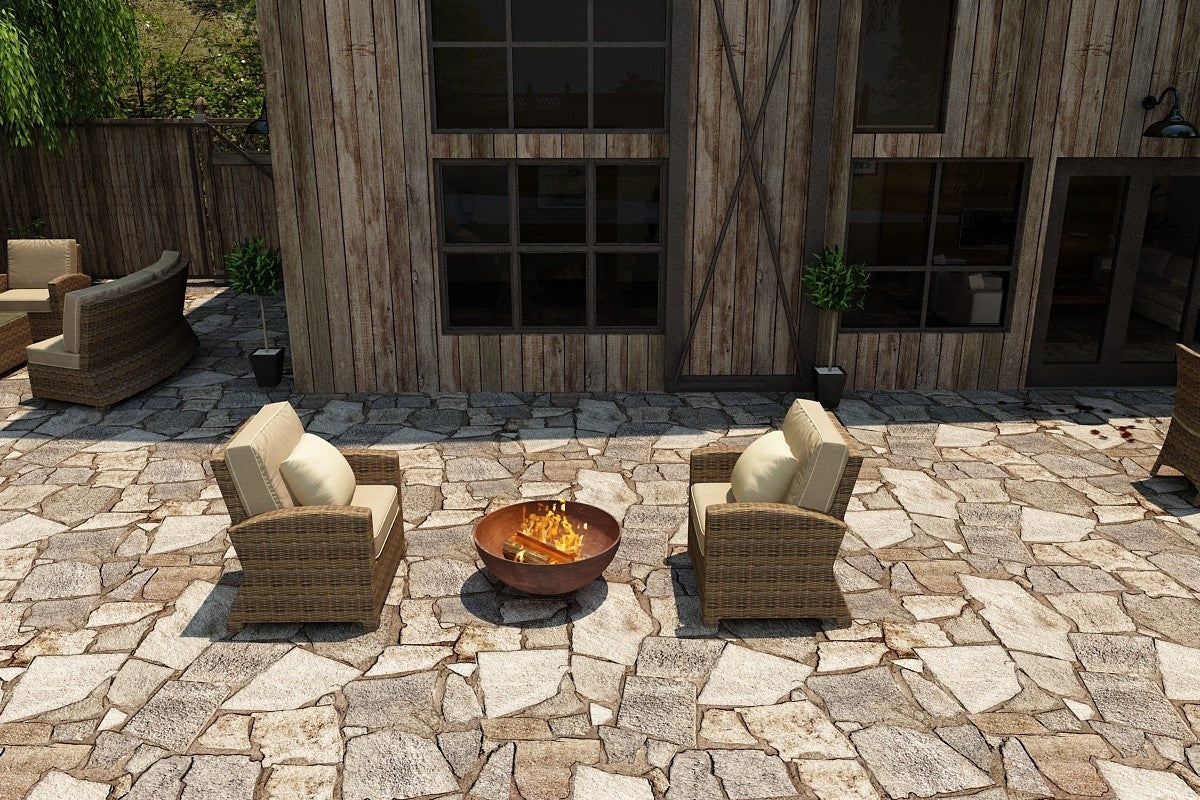

Stone Surrounds Are Not All the Same
Most people shopping for a fire table with a natural stone surround start by picking a color they like online, then work backward to figure out if it will hold up. That approach tends to produce regrets by year two.
The stone around a fire table is doing something more demanding than a kitchen countertop or an indoor fireplace mantel. It sits outside year-round, absorbs radiant heat from a burner that can push 75,000 to 90,000 BTUs, gets rained on, and in much of the country, cycles through freeze-thaw conditions every winter. Not every natural stone handles that combination gracefully. The three materials that come up most often in this category—travertine, limestone, and slate—each have genuinely different performance profiles, and the right choice depends on your climate, your patio style, and how much ongoing maintenance you’re willing to do.
Travertine: The Classic Choice with a Few Conditions
Travertine has been used around heat sources for centuries, which is part of why it keeps appearing in fire table designs. It’s a sedimentary limestone deposited by mineral springs, and its natural composition makes it non-combustible and heat-resistant. Around a gas fire table—where the stone sits adjacent to the burner tray rather than directly in the flame zone—travertine performs well under normal use.
The surface has a characteristic warmth to it. Cream, walnut, and gold tones are the most common, and they tend to complement both traditional teak furniture and more contemporary powder-coated steel frames. The pitted, slightly textured surface is also practical: it stays cooler to the touch than polished granite and provides better grip when wet, which matters on a patio where people are moving around barefoot.
The catch is porosity. Travertine absorbs moisture, and outdoors that creates two problems. First, spilled drinks, ash residue, and standing water from rain will stain an unsealed surface fairly quickly. Second, in climates with hard freezes, water trapped in the pores can expand and cause surface cracking over time. The fix is sealing—an outdoor-specific penetrating sealer applied before first use and reapplied roughly every two to three years. With that routine in place, travertine holds up well and, in many cases, actually improves in character as it weathers.
Finish matters more than most buyers realize. A polished travertine surface will show scratches and heat marks more readily than a honed or tumbled finish. For an outdoor fire table surround, honed or tumbled is the more practical choice. Polished looks striking in showroom photos but tends to show its age faster in a real backyard setting.
Limestone: Understated, Softer, and Worth the Tradeoff
Limestone and travertine are closely related geologically—travertine is technically a form of limestone—but in practice they behave somewhat differently as a fire table surround material. Standard limestone tends to be softer and more uniform in texture, with a fine-grained surface and a muted color palette that runs from pale cream to warm buff and light gray.
That subtlety is genuinely useful in certain design contexts. If your patio furniture is already visually busy—patterned cushions, a mix of materials, strong architectural details—a limestone surround sits quietly in the background rather than competing for attention. It suits minimalist and Scandinavian-influenced outdoor spaces particularly well, and it pairs naturally with light-colored concrete or sandstone pavers.
The performance consideration worth knowing: limestone has higher porosity than granite or slate, and some sources note it can be prone to spalling—where thin surface layers pop off—when exposed to repeated thermal cycling in direct heat zones. For a gas fire table, the burner is recessed into the tabletop and the stone surround isn’t in direct contact with flame, so this is less of a concern than it would be for a wood-burning fire pit ring. That said, limestone probably benefits more from a protective cover when not in use than travertine or slate does, and it should be sealed before the first season and maintained annually in wetter climates.
Cost tends to be favorable. Indiana limestone, for example, is quarried domestically and is generally more affordable than imported granite or specialty slate, which gives limestone-topped fire tables a reasonable entry price without sacrificing the authenticity of natural stone.
Slate: The Low-Maintenance Option for Modern Patios
Slate is the outlier in this group. It’s a metamorphic rock rather than a sedimentary one, which gives it a fundamentally different structure. The layered, cleft surface texture is distinctive—it reads as deliberately rugged rather than refined—and the color range skews darker: charcoal, deep gray, green-gray, and rust tones that create strong contrast against light-colored patio surfaces or pale furniture.
Durability is slate’s real argument. It’s one of the harder natural stones available for outdoor applications, it’s naturally cleft surface resists slipping, and its relatively low porosity means it manages staining and moisture better than travertine or limestone without the same sealing burden. In most cases, slate around a fire table requires minimal maintenance beyond periodic cleaning with a pH-neutral cleaner.
The design consideration is that slate’s aesthetic is specific. It works well in contemporary, industrial, or modern rustic settings. It tends to look out of place paired with ornate wrought-iron furniture or traditional teak sets that call for warmer stone tones. If your patio leans toward clean lines, dark powder-coated frames, and a more architectural feel, slate is probably the most honest material choice—and the one that will look as good in ten years as it does on day one.
One practical note: slate’s layered structure means it can occasionally delaminate at the edges if it’s cut thin or installed improperly. For a fire table top or surround, look for pieces that are at least 30mm thick and confirm the fabrication quality before purchasing.
Granite: The Case for Going Beyond the Three Defaults
Travertine, limestone, and slate get most of the search traffic for natural stone fire table surrounds, but granite is worth including in any honest comparison. It’s the hardest of the common natural stones, nearly impervious to staining, resistant to heat, and requires almost no maintenance beyond occasional cleaning. Its non-porous surface means freeze-thaw cycles don’t affect it the way they affect travertine or limestone.
Granite fire tables are available in a wide range of colors—from pale silver-gray to deep black to the iridescent blue of Blue Pearl granite—which makes it adaptable to more design contexts than slate. The tradeoff is that polished granite surfaces can feel visually cold in casual outdoor settings, and the price point for quality granite tops tends to run higher than limestone.
For buyers who want the look and feel of genuine natural stone without worrying about seasonal sealing or moisture management, granite is probably the most durable long-term choice. All Backyard Fun carries a full range of Oriflamme granite fire tables—made in the USA with authentic granite tops in finishes like Silver Tiger, Black Pearl, Blue Pearl, and Giallo Santo—for buyers who want that combination of stone authenticity and low maintenance.
What to Actually Look For When Buying
The stone type is only part of the decision. A few other factors tend to determine whether a fire table with a natural stone surround holds up over time:
Thickness. Thinner stone tops—anything under 25mm—are more vulnerable to cracking from thermal expansion and physical impact. Quality fire tables use tops in the 30mm to 40mm range.
How the stone is supported. A natural stone top sitting on a poorly designed base will flex under load, which eventually cracks the stone at stress points. Look for a rigid, level frame—typically powder-coated steel—with full perimeter support for the tabletop.
Sealing status at purchase. Some manufacturers seal the stone before shipping; others leave it to the buyer. Know which situation you’re in before the table arrives, because an unsealed travertine or limestone top sitting through its first rainstorm is not an ideal start.
BTU output relative to the burner placement. A burner producing 75,000 BTUs or more that sits directly beneath a thin limestone top with no thermal break is a different situation than a recessed burner with proper clearance. Reputable fire table manufacturers engineer their burner placement to protect the stone surface—it’s worth confirming this spec before buying.
Cover compatibility. Natural stone outdoors benefits from a cover when the table isn’t in use. Not every fire table ships with one, and not every aftermarket cover fits properly. If you’re investing in a stone-top fire table, factor the cost of a fitted cover into your budget from the start.
For buyers who want to compare stone finishes and burner configurations side by side, the fire tables collection at All Backyard Fun covers a range of natural stone and stone-look options across multiple sizes and shapes, with free shipping on most orders.
The Honest Summary
Travertine is the warmest-looking and most historically proven option, but it requires consistent sealing and benefits from a cover in cold climates. Limestone is subtler and often more affordable, with similar maintenance needs and slightly more vulnerability to direct heat cycling. Slate is the lowest-maintenance of the three, with a distinctive aesthetic that suits modern and contemporary settings well. Granite outperforms all three on durability and maintenance, at a typically higher price point.
None of these materials is a bad choice for a fire table surround when properly specified and maintained. The mistake is treating them as interchangeable—buying whichever looks best in a product photo without accounting for your climate, your patio style, or the specific engineering of the table you’re considering. Stone is a long-term investment in an outdoor space. Getting that decision right from the start is worth the extra research.