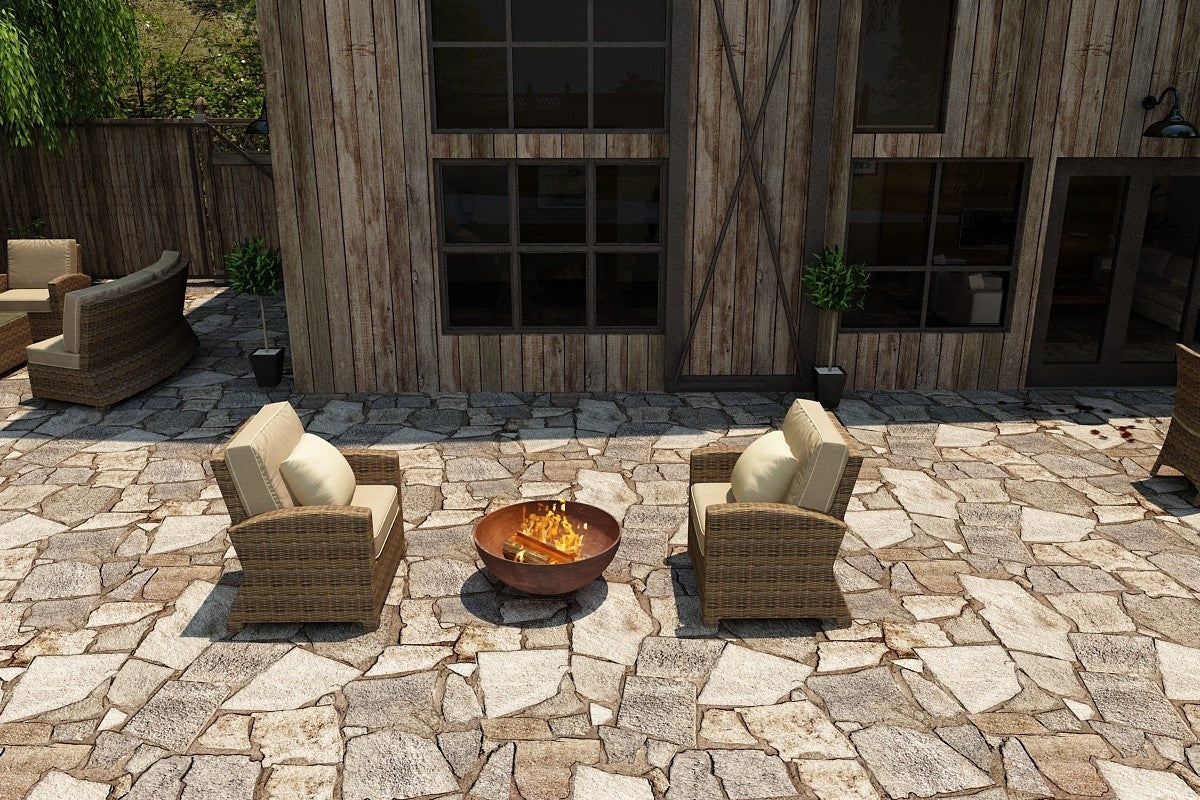

Start with the Footprint, Not the Fire
Most people pick a fire pit table the way they pick a rug—by what looks good in a photo. Then it arrives, and the patio suddenly feels like a parking lot. Sizing a fire pit table with a natural stone top requires a different approach: start with the total footprint the table and its seating will occupy, then work backward to the table dimensions that fit.
The general rule most landscape designers follow is that a fire pit table and its surrounding safe zone should take up no more than one-third of your total patio area. That leaves room for movement, furniture, and the breathing space that keeps a patio from feeling overcrowded. So before you fall in love with a 48-inch round granite table, measure your patio.
A few quick calculations go a long way here. If your patio is 12 × 12 feet (144 square feet), your fire table and its immediate clearance zone should occupy roughly 48 square feet or less. A 42-inch round table with chairs placed 24–30 inches from the edge fits that math. A 14 × 14-foot patio opens things up considerably—you can run a 48-inch round or a rectangular model in the 36" × 58" range and still have room to move. For larger patios of 18 × 20 feet or more, a full-size rectangular fire table becomes a genuine centerpiece rather than a compromise.
Sizing by Seating Count: The Numbers That Actually Matter
Patio square footage tells half the story. The other half is how many people you regularly gather around the fire. These two numbers together determine the table size that works—and they sometimes pull in opposite directions.
A compact 34-inch round table seats 2–3 people comfortably and works well on intimate patios or apartment balconies where space is genuinely tight. It produces enough warmth for a small group without dominating the space. If you regularly host 4–6 people—a family dinner, a few neighbors, a Friday night gathering—a 42-inch or 48-inch round table hits the sweet spot. Everyone stays close enough to feel the heat and hear each other without leaning in. For groups of 6 or more, a rectangular fire table in the 36" × 58" range changes the dynamic entirely: it functions more like an outdoor dining table with fire at the center, and it pairs naturally with a sofa on one long side and lounge chairs across from it.
One dimension that often gets overlooked is table height. Most premium fire pit tables are designed at coffee table height—around 21¾ inches—which sits slightly lower than standard patio chair seats. That height is intentional. It maximizes heat distribution toward seated guests and creates a natural conversation setting where everyone is oriented toward the flame rather than craning over it. A table that sits too high pushes heat upward and past the people sitting around it.
For seating clearance, a good working rule is 18–24 inches between the fire table’s edge and a guest’s knees. That gives comfortable warmth without the too-close feeling that makes people keep scooting back. Behind each chair, try to leave another 24–36 inches so guests can stand, move, and circulate without squeezing past each other. When you add those numbers up around a 42-inch table, you’re looking at a seating circle roughly 10–12 feet in diameter—which maps well to a 12 × 12-foot patio with a little room to spare.
Shape Matters More Than Most Buyers Expect
Round fire tables feel social. Rectangular ones feel architectural. That’s not just aesthetics—it changes how people actually use the space.
A round natural stone fire table pulls seating into a circle where everyone faces the flame equally. Heat distribution is even, conversation flows across the whole group, and the layout feels natural for casual entertaining. Round tables in the 42–48 inch range probably work for the widest variety of patio shapes and sizes, which is why they tend to be the most popular choice.
Rectangular fire tables, typically in a 36" × 58" format, suit longer or more linear patios. They pair naturally with a sofa or sectional along one side and two lounge chairs across from it, leaving one short end open for access to the burner controls and easy movement. If your outdoor space has a strong axis—a long covered porch, a side yard, a deck that runs along the back of the house—a rectangular table tends to feel more intentional and less like it was dropped into the center of the space.
Square tables occupy a middle ground. They work well with symmetrical seating arrangements: four chairs, two small sofas facing each other, or an L-shaped sectional. They tend to feel more structured than round tables, which can be an asset on a modern or minimalist patio where clean geometry is part of the design language.
Octagon-shaped fire tables are less common but worth considering for larger patios. The shape accommodates more seating positions than a round table of similar diameter while maintaining that inclusive, gather-around feel.
A practical note on natural stone top weight: granite and stone-surface fire tables typically run 150–200 lbs depending on size. That’s not a concern for most concrete patios or paver surfaces, but it’s worth confirming your deck can handle the load if you’re placing one on a raised wood structure.
Matching Table Size to Patio Type: A Quick Reference
Rather than a rigid formula, think of this as a set of starting points you adjust based on your specific space:
Small patios (under 10 × 10 ft): A 34-inch round fire table is about as large as you can go while maintaining safe clearance and comfortable movement. At this scale, a compact natural stone table with a single hidden propane tank—like the 34-inch Oriflamme Mini—fits without crowding the space. Seating typically maxes out at 2–3 chairs.
Medium patios (12 × 12 to 14 × 14 ft): This is where the 42-inch round and 40-inch square formats shine. You can seat 4–6 people, maintain proper clearance on all sides, and still have room for a side table or two. The 42-inch round is arguably the most versatile size in this range—large enough to anchor the space, proportionate enough not to dominate it.
Large patios (16 × 16 ft and up): A 48-inch round or a rectangular 36" × 58" fire table works here. The rectangle in particular starts to feel right at this scale, especially if you’re pairing it with a full outdoor sofa on one side. Heat output from larger tables—often 75,000–90,000 BTUs depending on propane or natural gas—covers a wider seating area, which matters more on a spacious patio where guests naturally spread out.
Covered patios and pergolas: Gas fire tables are generally the safer choice under overhead structures compared to wood-burning alternatives. Always check the manufacturer’s clearance requirements for overhead obstructions before installing any fire feature under a roof or pergola.
All Backyard Fun carries the Oriflamme natural stone fire table collection in multiple sizes and finishes—from the compact 34-inch Mini to the 36" × 58" rectangle—so there’s a format for most patio configurations. The Oriflamme line is also notable for its fully interchangeable parts, meaning the tabletop itself can be swapped out if you ever want to change the stone finish without replacing the entire table.
Stone Finish and Patio Style: Getting the Proportion Right Visually
Size is a number. Proportion is how the table actually looks in the space—and natural stone tops add a visual weight that purely metal or wicker fire tables don’t have.
Darker stone finishes like granite in Black Pearl or Silver Tiger tend to recede visually, which means a 48-inch table in a dark granite can feel less imposing than the same footprint in a light cream or white stone. Lighter finishes like Glacier Stone (a white fiberglass-reinforced quartz concrete) read larger and brighter, making them a strong choice for shaded patios or spaces that need more visual presence. Warm earth-tone finishes like Savanna Stone or Tropical Brown granite blend naturally into garden-style patios and spaces with wood decking or terracotta pavers.
The shape of your existing patio furniture also influences which table size feels right. A long sectional sofa pairs better with a rectangular fire table than with a small round one—the proportions stay balanced. Four individual lounge chairs work naturally around a round or square table. If your seating is mixed—a loveseat on one side, two chairs on the other—a round table in the 42–48 inch range tends to hold the arrangement together.
For the full range of natural stone and stone-finish fire tables available in multiple sizes, the Oriflamme fire table collection at All Backyard Fun is a practical starting point. Each model is available in multiple size formats, so you can lock in the right dimensions before choosing a finish rather than the other way around.
One last thing worth measuring before you order: the path the table will take from the delivery point to its final location. Natural stone fire tables typically ship via freight curbside delivery and weigh 150–200 lbs. A 48-inch round table needs at least a 50-inch opening to pass through a gate or doorway. It sounds obvious, but it’s the kind of detail that saves a difficult afternoon.