
The Shape Question Most Shoppers Skip
Most people shopping for outdoor fire pit tables spend their research time on BTU ratings, fuel type, and finish colors. Shape gets treated as an afterthought — something to decide after everything else. That’s backwards. The footprint of your fire table determines how many people can sit comfortably, how traffic moves around your patio, and whether the whole arrangement feels intentional or just crammed together.
Round and rectangular fire pit tables are not interchangeable. They behave differently in a space, they pair with different furniture configurations, and they create different social dynamics around the flame. Before you browse listings, it’s worth spending ten minutes understanding what each shape actually does to a layout.
Round Fire Pit Tables: How They Work and When They Win
A round fire table puts the flame at the center of an equal-radius circle, which means every seat is roughly the same distance from the heat. That geometry creates something that feels natural — closer to a campfire than a piece of furniture, with everyone equally close and equally warm. Conversation tends to flow without a “head of the table” dynamic because no seat is more prominent than another.
In terms of sizing, round fire tables most commonly range from 36 to 48 inches in diameter. A 36-inch round seats 2–4 people comfortably; a 48-inch round seats 4–6. For larger gatherings, a 60-inch diameter opens the experience further, though at that size you need a patio with real square footage behind it. As a general planning rule, allow at least 6 feet of clearance on all sides between the fire table edge and the nearest wall, fence, or structure — which means even a modest 36-inch round table needs a functional patio area of roughly 12 feet across.
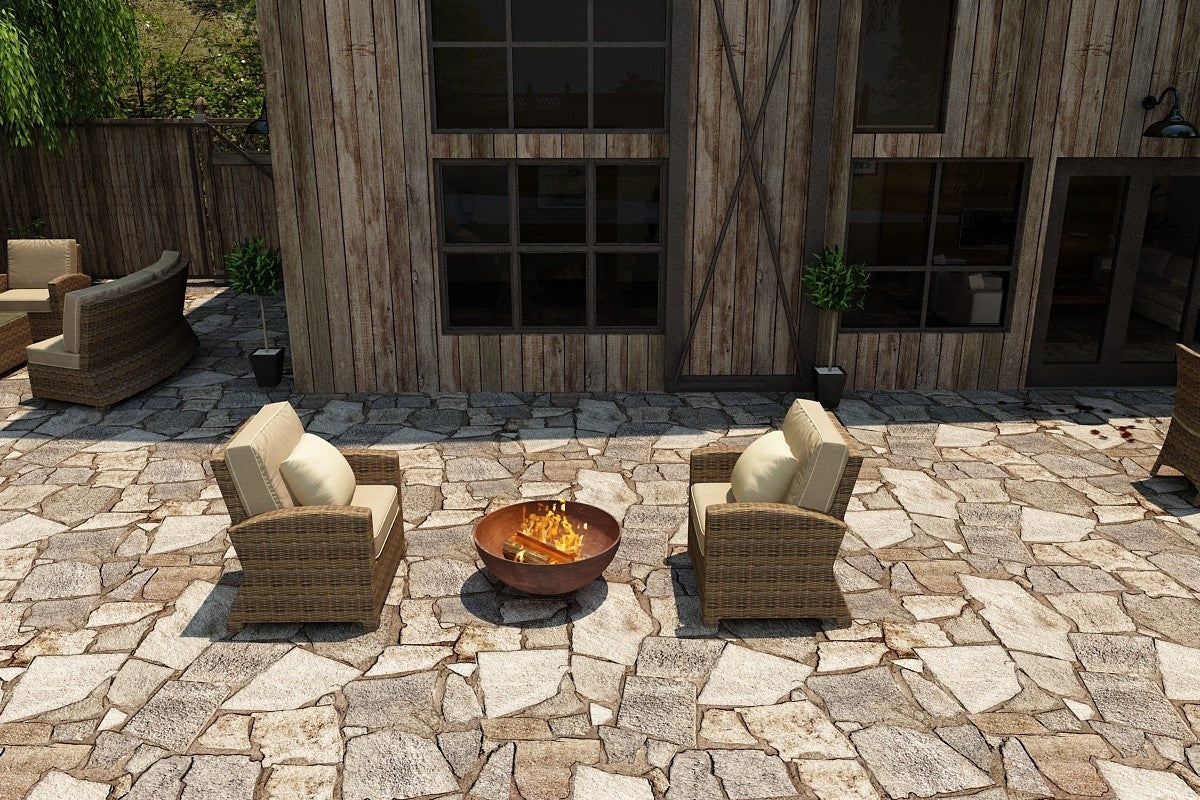
Round tables also tend to feel proportional on square patios. If your outdoor space is roughly equal in length and width — a 12×12 or 14×14 footprint, for example — a round table anchors the center without fighting the geometry. They pair well with four individual club chairs or Adirondacks arranged symmetrically, and they work beautifully with curved sectionals designed for circular seating zones.
Where round tables fall short: They don’t align naturally with straight-edged furniture like a standard sofa or a linear sectional. If your seating plan involves a long couch on one side and individual chairs on the other, a round table creates awkward gaps at the corners. They also offer less flat tabletop surface per square foot of footprint — the circular edge means less usable rim space for drinks and plates compared to a rectangle of similar overall size.
| Round Fire Table | Details |
|---|---|
| Common diameters | 36" – 60" |
| Seats (36") | 2–4 people |
| Seats (48") | 4–6 people |
| Best patio shape | Square or open/circular |
| Best furniture pairing | Club chairs, Adirondacks, curved sectionals |
| Tabletop surface | Moderate (curved edge limits usable rim) |
| Visual style | Organic, casual, campfire-feel |
Rectangular Fire Pit Tables: The Case for Linear Layouts
A rectangular fire table runs the flame along a linear burner, which means heat distributes down the length of the table rather than radiating from a single center point. For people seated along the long sides — on a sofa or a row of chairs — this is actually an advantage: the warmth reaches them evenly rather than concentrating in one spot.
Common rectangular fire table dimensions run 48 to 72 inches in length and 24 to 32 inches in width. A 60×28-inch table can seat 4–6 people in a dining-style arrangement; a 72-inch length pushes that toward 6–8. The longer profile fits naturally in elongated spaces — a narrow deck, a rectangular patio, or any layout where the seating runs parallel along two long sides.
This is where rectangular tables genuinely outperform round ones: sectional compatibility. If you already own or plan to buy a large L-shaped or U-shaped sectional sofa, a rectangular fire table slots into the open end of the arrangement like it was designed for it. The long edge of the table runs parallel to the long leg of the sectional, everyone gets warmth, and the layout feels resolved. You also get more usable flat surface along the long edges — useful for drinks, snacks, or covering the burner and using the table as a coffee table when the fire is off.
Rectangular tables also tend to be the more practical shape for narrow patios. A 60×28-inch footprint is far easier to fit into a 10-foot-wide deck than a 48-inch round table surrounded by chairs, because the rectangle can be oriented lengthwise to preserve walkway space on the short ends.
Where rectangular tables fall short: They don’t create the same equal-gathering feel as round tables. Seats at the short ends are further from the main heat source and can feel slightly outside the conversation. They also require more intentional furniture planning — a rectangular table dropped into a loosely arranged collection of chairs rarely looks as cohesive as a round table in the same scenario.
| Rectangular Fire Table | Details |
|---|---|
| Common sizes | 48"–72" L × 24"–32" W |
| Seats (60" L) | 4–6 people |
| Seats (72" L) | 6–8 people |
| Best patio shape | Rectangular, elongated, or narrow |
| Best furniture pairing | Sectionals, sofas, dining chairs |
| Tabletop surface | High (long flat edges) |
| Visual style | Modern, structured, resort-lounge feel |
Patio Layout Scenarios: Which Shape to Choose
Square patio, 12×12 to 14×14 ft, lounge chairs: A round table in the 42–48-inch range is almost always the better call. It fits the geometry, allows chairs to be placed symmetrically on all sides, and leaves enough walkway on each corner. A rectangle in this scenario tends to push furniture awkwardly toward the edges.
Rectangular deck or patio, 10×16 ft or longer: This is rectangular fire table territory. Orient the table lengthwise along the deck, place seating on the long sides, and you preserve walking room on the short ends. Trying to center a round table on a long narrow deck usually means the short ends feel empty and the long sides feel crowded.
Sectional sofa setup: Go rectangular, without much debate. A 60–72-inch rectangular fire table positioned in front of or parallel to the long leg of a sectional creates a cohesive outdoor living room layout. A round table in this scenario creates gaps between the curved edge and the straight sofa that are hard to fill gracefully.
Small intimate patio, 2–4 people: A round table in the 36-inch range is the right size and shape. It keeps everyone close, fits a compact footprint, and avoids the visual weight of a long rectangular table in a small space.
Entertaining-focused, 6–8+ guests: A large rectangular table (66–72 inches) gives you the seating capacity and surface area for a proper gathering. Pair it with a U-shaped sectional or two sofas facing each other across the long axis.
A Few Things Worth Knowing Before You Buy
Height matters as much as shape. Most fire pit tables come in two height ranges: coffee table height (roughly 18–24 inches) and dining height (28–30 inches). Coffee table height works with standard lounge seating and keeps the flame at a comfortable viewing level. Dining height works if you want to eat at the table or pair it with dining chairs. Mixing the wrong height with your existing furniture is a common and frustrating mistake.
Also worth confirming: the overall footprint versus the burner size. On many fire tables, the actual flame opening is considerably smaller than the outer table dimensions. A table listed as 60 inches may have a 30-inch burner — the rest is tabletop surface. That’s not a flaw, it’s useful space, but it’s worth knowing before you assume the flame will span the full length.
For shoppers looking at outdoor fire pit tables for sale across a range of shapes, sizes, and fuel types, All Backyard Fun carries an extensive selection of gas fire tables — including the Oriflamme line, which they own and manufacture — in configurations suited to both compact and large-scale patio layouts. Their Oriflamme gas fire pit tables in particular offer up to 90,000 BTUs in weather-resistant designs built for year-round outdoor use.
One practical step before purchasing: tape out the table’s footprint on your actual patio surface. It takes five minutes and eliminates the most common sizing regret — buying a table that looks right in a photo but overwhelms or disappears in the real space.
The Short Answer
Round fire tables work best on square patios with lounge chair arrangements, for groups of 2–6 people who want an equal, campfire-style gathering feel. Rectangular fire tables work best on elongated patios, with sectionals or sofa-based seating, and for groups of 4–8 who want more surface area and a structured layout.
Neither shape is objectively better. The right one is the one that fits the specific geometry of your outdoor space, the furniture you’re pairing it with, and the way you actually use your patio. Measure first, then shop.