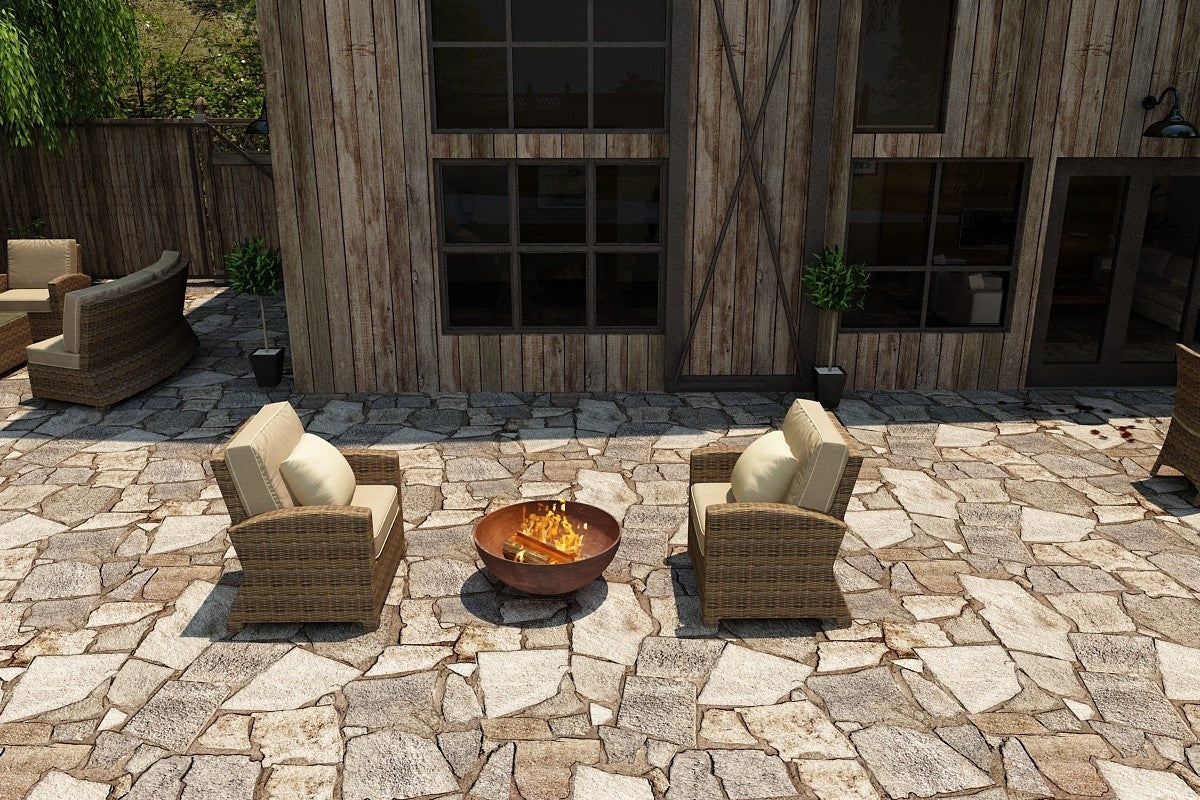

The Stone Beneath the Flame
Choosing a natural stone surround for a gas fire table sounds straightforward until you start pulling samples. Travertine, slate, and limestone all look plausible in a showroom. Outdoors, exposed to radiant heat, seasonal moisture, and the freeze-thaw cycling that quietly destroys porous materials, they behave very differently. The wrong call doesn’t announce itself on day one—it shows up two winters later as a network of hairline cracks or a patch of spalled surface near the burner opening.
This comparison focuses on three criteria that actually matter for outdoor fire table surrounds: aesthetics and design range, heat tolerance and thermal behavior, and long-term durability and maintenance load. Each stone has a legitimate use case. The goal here is to match the material to the situation rather than declare a universal winner.
One important framing note before the breakdown: none of these three stones belongs in direct contact with an open flame. Gas fire table inserts generate radiant heat at the surround surface, not direct flame contact, and that distinction is what makes natural stone viable at all. The stone sits around the burner opening, not inside it. With proper insert clearance—typically 1 to 2 inches between the burner pan and the surrounding stone—the surface temperatures a well-designed fire table surround sees are well within the tolerance range of all three materials.
Travertine: Warm Tones, Higher Maintenance
Travertine is a sedimentary limestone formed by mineral-rich spring water, and its most recognizable feature is the natural pitting and void structure across its surface. Those voids can be filled (honed or polished finish) or left open (tumbled finish), and the choice matters outdoors. Around a fire table, a tumbled or honed finish is the practical pick—it provides better slip resistance and doesn’t show heat-related surface marks the way a polished slab does.
The color palette runs from creamy ivory and warm beige to walnut and gold tones, which pairs naturally with warm-toned patio furniture and earthy outdoor settings. Architecturally, travertine has been used around heat sources for thousands of years, from Roman bath complexes to contemporary pool-deck fire features. It absorbs and slowly radiates heat rather than conducting it rapidly, which makes it comfortable underfoot and reduces the risk of sudden thermal stress at the surface.
The heat tolerance numbers are reasonable: travertine can withstand temperatures up to 1,200°F in appropriate configurations, which covers the ambient radiant heat of a residential gas fire table without issue. The problem isn’t the heat itself—it’s moisture. Travertine is porous, and water absorbed into its structure expands by roughly 9% when it freezes. In cold climates, that expansion happens close to the surface and can break off microscopic fragments over repeated cycles, a process called spalling. The void-fill material in honed travertine creates additional stress concentration points precisely where the stone is already structurally thinner.
For warm-climate installations—the Sun Belt, coastal California, the Pacific Northwest—sealed travertine performs well over many years. In freeze-thaw regions like the upper Midwest, New England, or mountain states, it demands more: thicker slabs (2-inch thickness is preferable over the standard 1.25-inch for cold climates), penetrating sealer applied before first use, and resealing every two to three years or when water stops beading on the surface.
Travertine Pros: Warm, organic aesthetic with strong design versatility; comfortable surface temperature; long history around heat sources; ages gracefully in mild climates.
Travertine Cons: High porosity demands consistent sealing maintenance; freeze-thaw vulnerable without proper preparation; void-fill areas are thermal stress points; not ideal for climates with hard winters unless properly specified and maintained.
Slate: The Most Forgiving Performer
Slate is a metamorphic rock—it was formed under intense heat and pressure, which is exactly why it handles outdoor fire environments better than either of the sedimentary stones in this comparison. Its density is notably higher (around 2.7–2.8 g/cm³), with very low porosity and water absorption. That low porosity is the key advantage: less water absorbed means less freeze-thaw damage, less soot retention, and easier cleaning. Soot and ash wipe away with minimal effort from a properly maintained slate surface.
Heat tolerance for slate runs up to 1,000°F without immediate damage, driven by its metamorphic formation process. The stone’s density means it heats and cools more uniformly than porous materials, reducing the thermal gradient that triggers crack development. This is the same property that made slate the traditional material for roofing and hearths across centuries of architecture.
The aesthetic range is narrower than travertine or limestone. Slate comes in deep charcoal, gray-black, muted green, and rust tones—colors that read as bold and contemporary rather than warm and traditional. It pairs well with modern fire table designs, dark powder-coated aluminum frames, and outdoor spaces that lean toward an industrial or transitional aesthetic. Each piece carries unique natural layering and texture, but the palette stays within a cooler, darker register.
Maintenance is genuinely low. Slate does not require frequent sealing the way travertine does, though a light application of penetrating sealer is still sensible for outdoor use to reduce any residual moisture absorption. Its naturally cleft surface texture also provides a non-slip grip in wet conditions—a practical benefit for a surface that people reach across to adjust burner controls or set down drinks.
The main trade-offs: slate tends to cost more than travertine or limestone per square foot, and its color range won’t suit every design direction. Homeowners building a warm, Mediterranean-influenced outdoor room will probably find slate too cool in tone. It can also be brittle along its natural cleavage planes if handled roughly during installation, so professional fabrication and setting are worth the investment.
Slate Pros: Lowest porosity of the three; excellent heat resistance from metamorphic formation; minimal maintenance; non-slip surface texture; resists soot staining well.
Slate Cons: Narrower color palette (dark and cool tones only); higher material cost; brittle along cleavage planes during installation; less suited to warm or traditional design aesthetics.
Limestone: Beautiful, But Placement-Dependent
Limestone is the most architecturally storied of the three materials—Indiana limestone built half of America’s civic buildings, and its soft, neutral tones have anchored traditional and transitional design for centuries. Around a fire table, it can look exceptional. The question is where exactly it’s placed and how close it gets to the heat zone.
Limestone is a sedimentary stone with higher porosity and weaker crystalline bonding than either slate or properly dense travertine. When exposed to the thermal cycling of outdoor fire use, those characteristics become liabilities. The sedimentary structure makes it prone to spalling—where thin layers of stone pop off the surface—under repeated heating and cooling. Limestone also contains microscopic pockets of moisture; under direct or sustained radiant heat, that moisture turns to steam and creates internal pressure. For this reason, limestone should be kept away from the immediate burner zone and used instead for the outer decorative surround, the table apron, or adjacent patio areas where heat exposure is indirect and moderate.
For gas fire tables specifically—where the insert sits in a defined opening and the surrounding stone surface sees radiant heat rather than direct flame—limestone at appropriate distance from the burner can work well. The rule of thumb used by professional fabricators is to keep limestone out of the zone directly adjacent to the insert opening and use it for the outer portions of the tabletop and base cladding. With appropriate sealing and proper joint spacing to accommodate thermal expansion, limestone in those positions holds up reasonably well in mild to moderate climates.
In terms of aesthetics, limestone offers the softest and most neutral palette of the three: beige, ivory, buff, and light gray tones that recede visually and let the fire and surrounding furniture carry the design. It carves and profiles more easily than slate or travertine, which is why it’s frequently chosen for detailed surrounds with molded edges and custom profiles. The softer surface also means it shows wear and etching more readily, particularly from acidic cleaners—pH-neutral stone cleaners are non-negotiable.
Limestone Pros: Soft, neutral aesthetic with broad design compatibility; easy to profile and detail; wide availability; works well for outer surround and base cladding away from the heat zone.
Limestone Cons: Highest spalling risk of the three near heat zones; porous and requires consistent sealing; mechanical strength decreases under sustained high heat; not suitable for placement directly adjacent to the burner opening.
Side-by-Side: How the Three Stones Compare
The table below summarizes the key performance differences for outdoor fire table surround applications.
| Criteria | Travertine | Slate | Limestone |
|---|---|---|---|
| Heat Tolerance | Up to ~1,200°F (ambient); avoid direct flame zones | Up to ~1,000°F; excellent thermal stability | Moderate; spalling risk under sustained heat cycling |
| Porosity | High (filled or open voids) | Very low | High to moderate |
| Freeze-Thaw Risk | High without proper sealing; needs 2" thickness in cold climates | Low; minimal water absorption | High; spalling risk from trapped moisture |
| Maintenance | Reseal every 2–3 years; pH-neutral cleaners | Minimal; occasional sealer application | Reseal regularly; pH-neutral cleaners only |
| Aesthetic Range | Warm ivories, beiges, walnuts, golds | Dark charcoal, gray-black, green, rust | Soft neutrals: buff, ivory, light gray |
| Best Placement | Full surround in mild climates; outer surround in cold climates | Full surround in any climate | Outer surround and base cladding only; away from burner zone |
| Relative Cost | Mid-range | Higher | Mid to lower range |
The single most important installation detail across all three materials is clearance at the burner opening. Most gas fire inserts specify 1 to 2 inches of clearance between the burner pan and the surrounding stone. Cutting that opening too tight concentrates heat at the stone edges and accelerates thermal stress cracking at the corners—the highest-stress location in the entire assembly. Slightly radiused inside corners, even a 10mm radius, reduce that stress concentration significantly.
Which Stone Should You Choose?
The honest answer depends on three variables: your climate, your design direction, and how much ongoing maintenance you’re willing to commit to.
Choose slate if you’re in a cold climate, want the lowest maintenance burden, or are building a contemporary or transitional outdoor space. Its low porosity makes it the most forgiving performer across a range of conditions, and its naturally cleft texture handles wet surfaces better than a polished stone. The darker palette isn’t for everyone, but for the right design context it’s hard to beat.
Choose travertine if you’re in a warm or mild climate and want the warmest, most organic aesthetic of the three. Sealed properly before installation and resealed every two to three years, it performs well in the Sun Belt states and mild coastal climates. In freeze-thaw regions, it’s still viable but demands more careful specification—thicker slabs, freeze-thaw-rated adhesives, and wider grout joints to accommodate thermal movement.
Choose limestone if your design calls for its specific soft neutral tone and you’re using it for the outer decorative portions of the table rather than the immediate surround around the burner opening. It works well as base cladding, apron detail, or for the outer tabletop area well away from the heat zone. Avoid placing it directly adjacent to the insert cutout.
For homeowners who want the look of natural stone without the porosity and maintenance concerns, it’s also worth noting that some of the best fire tables on the market use engineered stone surfaces—fiberglass-reinforced quartz concrete, for example—that deliver a genuine stone texture and appearance with significantly better resistance to thermal cycling and outdoor exposure. All Backyard Fun carries the Oriflamme fire table collection, which includes several natural and engineered stone top options that have been tested in real outdoor conditions for over 15 years. If you’re still deciding between a natural stone custom build and a purpose-built fire table, the Oriflamme lineup is worth a close look—the tabletops are fully interchangeable, so your stone choice isn’t permanent.
Whatever material you select, the fundamentals don’t change: proper sealing before first use, freeze-thaw-rated adhesives for any cold-climate installation, adequate burner clearance at the cutout, and a breathable cover when the table isn’t in use. Get those details right and any of these three stones will anchor your outdoor space for years.